
Congratulations on choosing family medicine! We are thrilled to welcome you to our specialty and want to help you match to the residency program that fits your personality and career goals. We hope the following pages answer some of your questions. Please fill out our Advising Request form to meet with one of our faculty advisors. You will be assigned an advisor who will work with you throughout application season. It is important to fill out your profile and grades as completely as you can, and as honestly as possible to get the best advice. None of our speciality advisors are involved in the residency selection process and your information will not be shared with anyone outside of the Advising team.
Helpful resources to learn more about applying in Family Medicine
UWSOM Guide to Applying in Family Medicine (updated each year)
AAFP: Strolling Through the Match (updated each year)
Preparing Your Application

Start by considering these questions:
What does your ideal future career look like? Where would you like to be geographically? What clinical skills will you need to reach your goals? Do you want more experience working with particular populations? Do you prefer working in larger or smaller settings?
Consider your personal circumstances. Do you prefer living in a particular state or region? Where does your social support system live? Do you have a partner? Children? What community resources will you and they need? Will you be couples matching?
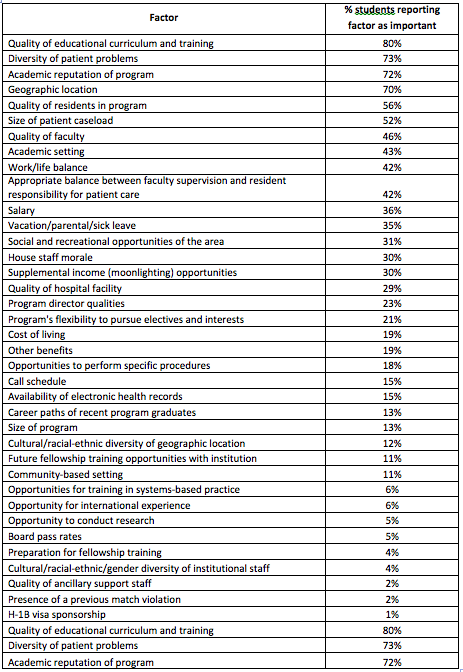
What do others find important? The following is a list of factors that US seniors identified as important when they were deciding on which residency programs to apply and interview. The table is listed in the order of percent of students reporting this factor as important. There are also some factors that were not on the survey that you may find significant, and there may be some factors not listed here that are critical to your own personal search. Use this table as a starting point to figure out what you want out of a residency program and how important each factor is to you.

From NRMP. (2025). Charting Outcomes: Applicant Survey Results, 2025 Main Residency Match.
Students frequently ask about how to assess residency programs, including how to figure out how competitive a program is. There is no “Top Ten Family Medicine Residency Programs” list that tells you the best and most competitive residencies. Instead, each program has different strengths that will be a good fit for students with different career goals. Figuring out what is important to you during residency will help determine which programs are a good fit to meet your needs and training desires.
A program’s “competitiveness” can mean two, things. It can be a marker of its prestige OR it can indicate how difficult it is to match to the program because they have a strong applicant pool. Clearly these two are related, as more prestigious programs may have more applicants and thus be more difficult to match into. However, popular or prestigious programs may be a poor fit for applicants because they do not meet the applicants’ individual training needs and desires. Try to keep these concepts separate when you are assessing programs – it’s fine to determine the prestige of a program, but more importantly, determine how hard it may be to match to a program so you can make informed choices about your chances of getting to train there. And above all, don’t forget about fit. All the prestige in the world won’t do you a bit of good if the program does not offer the training you want.
- FREIDA (good for general information about residencies)
- AAMC Residency Explorer (has helpful application and match data)
- AAFP (can search by program strength, pregnancy care training, etc.)
- WWAMI Programs (information specific to WWAMI network residency programs)
- RGC State Map Collections. For students interested in rural or underserved careers – tells you the percent of grads from the residency that go on to practice in those areas (choose the state you want to explore, then scroll down and click on Residency Footprint Maps.)
- Prior year match rates. One way of assessing a program’s competitiveness is to look at prior match rates.
- Board pass rates. You can see board pass rates.
Once you have identified programs you are interested in, make sure to visit their websites for detailed information. The websites usually have information about their mission, program curricula and a list of current residents and faculty. You can also contact prior UW grads that are residents or faculty at an individual program to get more information about the program.
The short answer is that there is no magic number. It depends on many factors and you will need to take both your own competitiveness AND the competitiveness of the programs you are applying to into account. Additionally, you may have extenuating personal circumstances (such as a partner in school in a particular city who can’t leave) that may make you feel you need to limit your search to that geographical area.
There are two ways of thinking about programs that will help you determine how many you should apply to. The first is to work backwards from how many programs you want to include on your rank list. The second is to categorize the programs based on how easy you think it will be for you to match into.
Reviewing data for US seniors from the 2024 match can help you know how many programs you should rank. Essentially, all family medicine applicants that listed more than 10 programs matched. The take-home point is that the average student, ranking 10 programs will likely ensure a match. Work backwards from this number to account for attrition of programs during the application and interview process. Most students have 1-2 programs they do NOT want to attend after the interview and some students will not get offered interviews at every program they apply to. Furthermore, some students will get interviews but may decide not to attend them from a variety of reasons. Therefore, an average student would need to apply to about 12-15 programs to account for not getting interviewed at 1-2 programs and possibly not liking 1-2 programs after interviews to be able to have a rank list that is 10 programs long. For this average student the application process may look like this:
- Applies to 12-15 programs
- Interviews at 12 programs
- Ranks 10 programs
Using three broad categories (stretch, likely, and slam-dunk) of programs can also help you build a list.
Stretch: The program is more competitive than you are as an applicant
Likely: You and the program are about equal. It is likely that you will match.
Slam Dunk: You are more competitive than the residency program, it should be a safe program to assume a match.
The concept of these categories does not obviate the need for good fit. Conversely, identifying programs that are good fit will allow you to be a more competitive applicant for those programs.
How many programs from each category? Again, it depends on your competitiveness. An average student may have 2-3 stretch programs, 3-4 likely programs, and 2-3 slam-dunk programs. Students that have faced difficulty in school and are less competitive may need a longer rank list with more likely and slam-dunk programs.
What do you do if you have circumstances that limit your match to a single geographic area or to a few programs? If family is involved talk to them honestly about what you think the chances are to match in your coveted area/programs. Discuss long-term ramifications if you don’t match (SOAPing to a place you weren’t expecting or reapplying the following year- you less competitive the second time around.) Keep in mind that residency in only 3 years long and that you are choosing a specialty that will let your work anywhere when you are done.
This question is a complex one that we recommend you talk through with a Family Medicine specialty career advisor. Some things that would suggest you are an average applicant:
- You passed all foundations courses and STEP 1 and STEP 2 on the first try.
- On your clinical rotations, you got mostly a mix of High Pass and Honors grades.
- You anticipate fairly strong Letters of Recommendation from Family Medicine (from clerkship and/or a sub-I).
You may adjust up or down based on these basic data, but there are some applicants that can be very strong candidates for the right programs even if they have faced significant academic challenges. For this reason, it is important to know which programs you are interested in, your own personal goals as a future family physician and be ready to be passionate about what the residency community cares about. Family Medicine specialty advisors can help you review your priorities and your list of programs with you.
The best personal statements are memorable. They paint a picture in the mind of the reader and tell a story about who you are, how you got here, and where you want to go. The personal statement is vitally important because it is frequently used to help determine who gets interviewed and ranked.
There are excellent resources on the SOM Career Advising page to help you create your personal statement. Here are some Family Medicine-specific pieces of advice for you to consider.
Overarching theme:
Review your CV and think about the experiences before and during medical school that inform what kind of family physicians you will become. Often there is a common thread that holds together even the most disparate of experiences; usually one of your core values as a person. Identify this theme and write your personal statement so the reader could easily recognize what it is after reading your statement.
Experiences to highlight:
Be specific – talking about the aspects of care that you like in Family Medicine is good, but it’s even better when programs can see how your personal experiences reinforce aspects of family medicine that resonate with you as a person.
It’s okay to include patient vignettes and talk about your accomplishments, but be sure to relate it back to yourself. How did the experience impact you? What did you learn about yourself? How will the experience make you a better family physician? What about the experience demonstrates your commitment to the discipline of family medicine, your ability to work with others, your ability to work with patients? Choose one experience and tell a story. This is a good way to open your statement, to develop your theme and make it memorable.
Commitment to specialty:
Commitment to family medicine is one of the most important qualities for family medicine residency programs. They want to know that you know the specialty mission and values. Talk about why you are choosing family medicine. What experiences convince you that this is the right field for you?
Strengths that you bring:
What do you bring to a program? What are you naturally good at? What skills do you have that will serve you well in residency?
Future plans/what you are looking for in a residency program:
At the end of this long road of school and training, what kind of work do you see yourself doing? What kind of work will give you a sense of purpose and joy? What types of training and environment are you seeking during residency to be able to accomplish this goal?
Don’t forget!
Occasionally there will be programs that request that applicants customize their personal statement for their program (e.g., in last paragraph, write why you are applying to their program specifically). We strongly recommend that students check each program website before applying to look for possible customization requests.
Sample Outlines for Personal Statement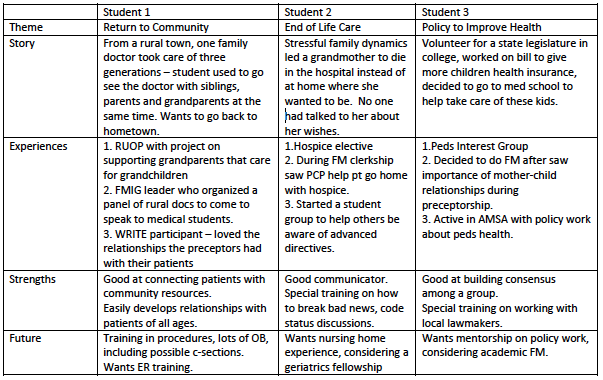
Letters of recommendation are very important. Over 80% of program directors rate them as an important element used to help decide whom to interview (2024 NRMP data).
Who to ask:
- The minimum requirements for a letter writer are: someone who can comment on your clinical abilities (from clerkship or sub-I level rotations). AND who you know thinks you did a good job.
- At least one letter should come from a family physician. The other letters can come from physicians in any specialty. Additional letters from family physicians or other physicians in primary care fields can help strengthen your application by indicating your commitment to family medicine.
When you request a letter:
- Ask the individual if they would be willing to write you a “strong letter of recommendation.”
- Give the letter writer plenty of time to get your letter in, at least one month.
- We recommend getting a commitment for a letter in writing (confirm early by email).
Number of letters:
- You should have a minimum of three letters of recommendation – some programs will accept more (check their websites).
- Do not submit more letters of recommendation than a program accepts.
- Rarely a letter writer will not come through with a letter. Be sure to request at least one back-up letter to prepare for this. Ask 4-5 people for letters to ensure you will have the minimum number required.
To get great letters of recommendation:
- Ask physicians who know you well for letters. You should ask for letters from faculty physicians who have directly observed your clinical skills. Important things that residencies want to see in a letter include your clinical knowledge, your willingness to learn, your ability to work with other members of a team, and your ability to work with patients.
- Provide your letter writers with your photograph and a draft of your personal statement and CV. The photo ensures that the letter writer is writing about whom they think they are writing. The CV and personal statement give the letter writer more information about you that can help them round out your LOR. If you are not done with your PS, write a paragraph that helps your letter-writer know what to emphasize (your perceived strengths, what memorable patient encounters you might have had on that rotation with that faculty member, areas of growth, etc.)
- Ask for letters as soon as possible. It’s easier for a letter writer to remember specific examples of your skills right after a clinical experience.
- Be sure your letter writers indicate your interest in family medicine. A letter that states that you would be a great resident without naming the specialty could be viewed as a “generic” letter and perhaps a sign that you are applying to two specialties in the match.
- Share these tips for writing a LOR when requesting a letter: LOR Writing Tips for Faculty (updated 2025)
Avoid these pitfalls:
- Asking for a letter from the chair of the Department of Family Medicine. It is not needed for Family Medicine applications.
- Letters that do not at all relate to family medicine. You may have demonstrated amazing surgical skills during your neurosurgery elective; however, most family medicine residencies will not be interested in your ability to perform a laminectomy. A letter from a neurosurgeon could be a good letter if it comments on your skills on the wards, in clinic, or on a team.
Though applicants no longer upload their CVs into ERAS (instead, you manually enter relevant experiences into text boxes), having a CV as a student is a good idea. CVs are a critical tool for professional development. The UWSOM Career Advising team offers the UWSOM CV template that includes commonly cited experiences from medical school such as TRUST, WRITE, Pathways, RUOP, etc.
Students wonder if they should include activities before medical school on their CV. Definitely include all awards and honors from college onward. Unless you did something unbelievably amazing in high school, leave these activities and awards from this part of your life off your CV. It’s okay to include pertinent college activities for which you made a substantial commitment.
The Interviews
Setting up Interviews
Different programs have different ways of assessing applicants and offering interviews. Some programs will offer interviews based entirely on a set of criteria that can be deduced quickly from an application (e.g. certain board scores, UW student, etc.). These programs may get back to you very quickly (as early as the day applications are available to programs). Other programs have a holistic application review process and it can take a few weeks~couple months to get an invitation to interview.
It’s a good idea to have a rough idea of what order and what weeks/months you would like for your interviews so when you get an invitation you can reply quickly to schedule. Once you are offered an interview, make sure you schedule it as soon as you can– there tends to be a larger pool of interview dates from which to choose.
Residency program coordinators are very important people in your residency application experience. They are the people you will e-mail or talk to on the phone to schedule your interview and will likely be the first people to greet you on your interview day. Remember to be respectful too everyone you interact with during the whole process.
Order of Interviews
You will hear many theories on the best way to order your interviews. One effective strategy is to schedule interviews at your top choices in the middle of your interview season. This way you will be comfortable and familiar with the process of the interview. Most programs have set “interview days” (e.g. Tuesdays and Fridays). Some will finish interviewing in December, and some go through January.
If You Have Not Heard From a Program
Consider sending them an email outlining why you are specifically interested and/or excited about their program. It never hurts to check in if you think that you should have received an interview offer. If you send an email and do not hear back in 2-3 days, give them a call.
Dress for Success
If you are doing in-person interviews, remember that this is a job interview business attire is the accepted norm. You want to give the appearance of a successful, mature physician, not a medical student who has been up all night studying. You will need to buy a suit. Your outfit should be neat and comfortable.
Canceling Interviews
If you need to cancel an interview, emailing the program coordinator is appropriate when done with advanced notice (at least one week). Call the program to follow up if you receive no email response. This way the program can give your interview slot to another applicant.
Do:
• Do respond to the program in a timely manner regarding acceptance/decline of interview or any special events, including pre- or post-interview dinner.
• Do contact the program promptly if you need to cancel your interview.
Don’t:
• Cancel your interview the day before the interview.
For each program you will have general things you want to assess as well as things specific to the individual program that you want to explore.
General Attributes
It is good to come up with a list of attributes you want to assess for each program. To figure this out you will need to determine what you want in a residency and associated community. These are three formative years in your training and it is vital that you receive quality training.
Some common factors students assess of a residency include:
- Patient Volume– enough to learn and become more efficient without being overwhelmed?
- Diversity of training experiences –types of patients (peds, OB, adults, etc.), background of patients, types of visits (acute, preventive, chronic disease).
- Supportive learning environment in which the resident is challenged yet has the support structure to learn. Balancing these two will be variable between different individuals; you must find a place that will fit your style and needs.
- Hospital and clinic size – will you be more comfortable learning in a small community hospital or in a tertiary care center?
- Collegial learning environment – what does the learning environment feel like? Is the resident part of a team of learning?
- Emotional support – how does the residency support wellness, prevent burnout and address residents in trouble emotionally and academically?
- Good fit – the feel for the place and the people you meet. Are these people you want to spend 3/4 years with? In the end, the general feel for the place affects deeply the choice of residency. This is an important part of residency selection.
- Opportunities to teach- is there a culture of peer teaching? Do resindents teach students?
- Graduate success – are the graduates of the program doing what you want to do when you are done?
Some common factors students assess in a community include:
- Social connections – churches, families and partners, activities
- Needs of children – childcare, schools
- Needs of significant others – employment/educational opportunities
Below is a list of factors that students who matched in family medicine reported as important to them in ranking programs highly. Use this as a guide to create your own list.
Specific Program Attributes
It’s also good to have some things that are specific to an individual program that you want to explore. To develop this list, you first need to do some research:
- Review all the information a program sends you.
- Visit the program’s website – review the program’s mission statement and their goals.
- Research the faculty/residents.
- Consider contacting any UW graduates in the program.
To prepare for the individual interview experience:
- Ask for an interview schedule ahead of time if it was not included.
- Ask the program what to expect and what materials to bring for the interview day.
- If you know who will interview you, research those individuals more carefully through the website.
Prepare Your Questions
Based on the needs and wants you identified above, brainstorm a list of information you wish to find out during your visit. Prepare a list of questions for residents, faculty, and staff.
- Have a list of different questions for different people. You may want to ask the program director different questions than you ask the staff.
- Avoid general questions like “What are the weaknesses of the program?” Instead, try to ask about specific information you want to know about the program. For example, “what is the pediatric inpatient volume in the residency” “How many deliveries does a resident typically have at the end of residency?” “How independent is a resident in the inpatient service?” “How is supervision in the clinic done?”
Below is a list of possible questions for each group of people you interact with:
Program Director
- What is the success of graduates (for areas that you particularly care about): finding jobs/fellowships, board scores?
- How is the stability of the program? Accreditation, turnover of faculty and staff
Faculty
- What are the clinical, non-clinical, and administrative responsibilities of the residents?
- How are residents evaluated? How often, and by whom?
- How do residents give feedback to the program?
- Are there research or teaching opportunities?
- Do you foresee any changes in the next three years?
Residents
- How is it working with the faculty and the program?
- What is the average daily workload for interns? Is it varied?
- How much didactic time is there? How it is prioritized?
- What types of clinical experiences do residents have?
- What is the work schedule? Call schedule?
- What are the patient populations in the clinical environment?
- Are you happy? Was this a good match for you?
- How do residents work together and socialize as a group?
- Are there moonlighting opportunities?
- How competitive was it to match to this program?
Staff
- What is the rotation and call schedule like?
- What are the parking and transportation options?
- How does the residency schedule electives and away rotations?
- What is the city/town/area like?
- For residencies that have specific tracks – what are they like?
- Which residents and faculty should I talk to about my interest in X (OB, sports med, etc.)?
- While on call, what do residents get in terms of meals and call rooms?
Questions Not to Ask
These are topics you should try not ask during the interview. Most of this information will be in the packet they send you or covered in an introductory meeting. If not, they can be addressed in a follow-up email to the program coordinator, who will probably connect you with an HR representative.
- Salary
- Benefits
- Vacation
- Family Leave
Do:
- Your homework before the interview. Know something about the program, the people, and the director.
Don’t:
- Select a residency based on their pay rate. If you are truly strapped and can’t live without the difference in pay from one residency to another, only then should this be a consideration. However, when you are out of residency 10 years, the few thousand extra dollars will likely seem much less important than they do at the time of entry into residency. You will certainly feel the pain after residency if you have not met your training needs.
- Fixate on one thing during your interview (one particular accomplishment, one aspect of the program, etc.)
Prepare to answer all types of questions during your interviews, including very open-ended ones and ones that may probe weaknesses that appear on your application.
Know Yourself
- Make a list of your top strengths, goals, values, accomplishments, and abilities to use as a general reference for all interview questions.
- Develop your TOP 5 list. Go into every interview with 5 key things you want a program to know about you. What makes you a good candidate? What makes you unique?
- Know your weaknesses. If you encountered academic difficulty you will probably be asked about it during your interview. Know what you will say ahead of time and reframe it in a positive light. Example: My father became very sick a few weeks before I took step 1 and I did not pass on my first attempt. I learned from this experience how to manage my education even in the face of personal difficulty. Though he was still sick when it came time for step 2, I passed the first time I took it.
What Interviewers May Ask
Prepare to answer the most common question: “What questions do you have for me?” Many residencies want to see that you’ve thought carefully about their program and that you’re applying to them because you are interested in the unique things their program offers. This is your opportunity to let them know you’ve done your homework. See the above section for some examples of questions you could ask.
Here is a list of potential questions you may be asked. Practice your answers ahead of time.:
- How are you today? (there are NO innocent questions)
- Tell me about yourself.
- What are your strengths and weaknesses?
- Why are you interested in Family Medicine? (#1 question asked)
- What other specialties did you consider?
- Why are you interested in our program?
- What are you looking for in a program?
- Why should we choose you?
- What can you contribute to our program?
- How well do you feel you were trained to start as an intern?
- Describe your learning style.
- Tell me about… item(s) on your CV or transcript, past experience, time off, etc.?
- Can you tell me about this deficiency on your record? (Do not discuss if you are not asked)
- What do you see yourself doing in five (ten) years?
- What do you think about… the current and future state of healthcare, this specialty, etc.?
- What do you do in your spare time?
- Present an interesting case that you saw during medical school.
- Tell me about a patient encounter that taught you something.
- What would you do if you knew one of your more senior residents was doing something wrong (e.g. filling out H&P’s without doing the evaluations, tying someone’s tubes without consent, etc.)?
- Which types of patients do you work with most effectively? Least effectively?
- How do you make important decisions?
- If you could no longer be a physician, what career would you choose?
- How do you normally handle conflict? Pressure?
- What do you think about what is happening in… ? (non-medical current events question)
- Teach me something non-medical in five minutes.
- Tell me a joke. (Keep it simple and tasteful)
- What if you do not match?
- Can you think of anything else you would like to add? (Always add something!)
- What is your vision of yourself in FM as a specialty?
- What do you think will be difficult for you in residency and how do you cope with it?
- Who are your role models and how did they affect the way you want to practice medicine?
- How do you see yourself being involved in health reform?
There are some questions that are not allowed during interviews. If you are asked one of these, you can simply reply that you are not comfortable answering that question. “Illegal” questions might include:
- What are your plans for a family?
- Are you married? Have any children?
- How old are you?
- If we offered you a position today, would you accept?
- They are also not allowed to ask where you are applying or ranking
Prepare Your Two-Minute Drill
This is a great response to an open ended question like “Tell me about yourself.” One way to organize your 2 min would be:
- First fifteen seconds is a brief review of who you are (e.g., “My name is _____. and I’m from the UWSOM in Seattle, WA…”).
- The next thirty seconds is a review of your educational background, undergraduate degree, work experience, and life experience.
- The next thirty seconds is a review of special attributes from medical school, such as leadership positions, family medicine experience, or other experiences that led you to the decision for this specialty.
- Final fifteen seconds is a review of why you’re interested in this residency specifically and what attracted you to this place here and now.
- Optional closing if this question does not occur during the interview: “Tell me more about the residency or about your position with the residency.” This leads the way for the interviewer to introduce him/her self and the residency.
This is intended as an icebreaker that gives the interviewer enough information about you and your background and interests to start a longer conversation. Make this two-minute drill personal; you don’t need to follow the suggestions above exactly. In practicality, you may have 10 minutes of material that you have memorized and rehearsed that will allow you to mold the two-minute drill to any situation.
Mock Interviews
Do a mock interview. A mock interview can be done by family or friends, your advisor or mentor, and the UWSOM Career Advising team also offers a mock interview for every student. Prepare as if it were a real interview: review your answers to specific questions, have a list of questions you plan to ask, and if possible, dress as if it were a real interview.
Plan to treat every interview as though it counts and do not use your first interview as “practice,” because you may find that you really like the program.
Do:
- Be prepared to address any potential red flags in your application, including extension of training, USMLE failure, or clerkship failure. Programs are checking to see if you have insight and have taken action to correct the problem. Honesty is much preferred over defensiveness or excuses.
- Practice the length of your responses.
Don’t:
- Talk for too long (aim for a few minutes per question max)
- Go off on tangents
The purpose of the interview is for both parties to learn about each other to determine if the applicant and residency are a good fit. This is a time for you to get to know them and for the residency to get to know you. It is an opportunity to learn and explore.
Most FM programs offer a virtual option, but some are moving toward in-person. It is a good idea to check program websites and other data sources to see what type of interview is being offered.
The entire experience is the interview. If you are with someone from the program – staff, faculty, or residents – you are being interviewed. Any one part of the interview process can make or break your chances of getting into the program.
Pre-Interview Events
The dinner and social hours that residency programs hold before interview day are a great way to learn more about the program and get a feel for the residents and faculty who may be interviewing you the next day. Even though this will be a more informal event, remember that your interactions during these pre-interview activities will be included in the program’s discussion of you after you’re gone. If it will be difficult to get to a in-person pre-interview event due to travel (for example, if your flight lands at 8PM the night of the dinner), let them know that you are unable to make it due to your travel schedule.
What to Bring (if in person)
Copies of your CV, personal statement, and transcripts, your lists of questions you wish to have answered, and a note pad with you as you would for your interview (use a nice portfolio). Bring outerwear for bad weather and breath mints for after lunch.
Getting to the Interview
BE ON TIME. This cannot be overemphasized. This is important for all types of interviews. Test your technology in advance if virtual and check out the location beforehand if in person so you don’t get lost.
Shining in the Interview
For the actual face-to-face interview, make sure to make good eye contact, introduce yourself, and if you’re asked the open ended question, “tell me about yourself,” use your two-minute drill. Questions can be repeated from interviewer to interviewer.. Try to sound fresh and positive even if you have answered that same question 5 times. Your questions will change depending on whom you are talking with. For example, residents will know more information about call schedules and the intricacies of different rotations. Prepare a group of questions for each time of interviewer – resident, staff, faculty, and the program director.
Make sure to:
- Not ramble.
- Listen to the questions asked, and understand what is being asked, and answer the question that was asked.
- Not answer a question they asked or add too much tangential information.
- Be comfortable with pauses, silence – stay poised and confident
- Sound fresh every time – be prepared to answer the same question throughout the entire interview process.
- Smile! It’s highly underrated and often forgotten when nervous or tense.
Shining Throughout the Day
Remember that you will be “on stage” for the entire day. Treat everyone with respect; everyone you meet before the interview and on the interview day will be involved in the decision about your application to the program. Everyone, including administrative staff, have a voice in the resident selection.
Interviews are draining emotionally and physically. Maintain energy and interest throughout the entire day. If you need a minute or two away to regain your brain, excuse yourself to the bathroom, get a drink of water, or find some way to get a minute or two by yourself.
Accept invitations for future contact. If residents offer you their cards, take them. You can send them an email later to let them know how much you appreciated their time and ask any lingering questions. Take faculty member’s contact information when offered and reconnect with them to let them know mow much you appreciated their time.
What does a residency look for in an applicant?
The following is a partial list of things programs look for in applicants during the interview:
- Knowledge base
- Academic progress and trajectory of clinical skills
- Initiative – self-motivation is an important part of being and learning as a resident
- The ability to recognize one’s own limitations or knowledge gaps. The program wants residents that can recognize and find a solution to a knowledge gap or deficiency in a specific skill. Accurate self-assessment is a lifelong process of being aware of one’s knowledge and one’s limitations.
- Motivation
- Personality – warmth, caring, compassion, maturing, self-awareness
- Ability to work under stress
- Ability to ask for help
- Commitment to work and get the job done
- Excellent communications skills
- Maturity
- Fit with the goals of the program
- Fit with the residents and staff at the program
After your interview, you will have a lot of information that you will use to determine the program’s rank on your rank order list. You may also decide you need additional information for programs you are very interested in.
Reflect on the Interview
As soon as possible after the interview, take time to write down your thoughts and impressions. Ideally this would be done the next morning, after your head has cleared from the interview day but when you still remember lots of details. You will also want to write down any questions that may come up after the interview day and a list of contact information of residents and faculty for follow up questions.
Students employ various methods of determining how impressive they found an individual program. Most people use some combination of a scoring sheet and their gut reaction to the program. It is important not to rely too heavily on either one – the overly analytical or the overly instinctual. When it comes to make a rank list, students do best if they keep both in mind. This way, you won’t be swayed by a single charismatic resident at a program, nor will you go to the residency that got the highest score but where you did not feel a good connection with the people there.
Sample residency Scoring Sheet – Residency XYZ: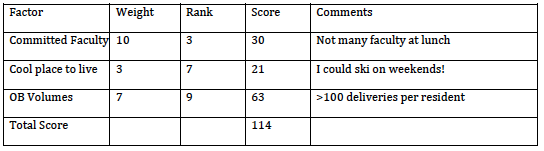
Contact after the Interview
Consider sending thank you cards or a thank you email to your interviewers. If you have questions that come up after your interview, contact the residency or faculty who gave you their information.
A second look is a half-day or day that you set aside to come back and visit programs that you are most interested in. It clearly communicates to the program that you are interested and it allows the program to get to know you outside of the interview day. You should contact the program coordinator to see if they will help you to set up a second look. Second looks should not influence how a program ranks applicants.
Do:
- Send thank you card/emails in a timely fashion.
- Take time to really reflect on your interview day.
- Consider a second look for one or two programs you are really interested in and are having trouble deciding between.
Don’t:
- Send “love letters” which indicate a program is your top choice. It is not necessary to do this and we do not recommend it.
- Send an administrator a single envelope full of thank you cards to distribute to your interviewers.
- Send an email to a resident or student with 10 questions that would require 3 pages each to answer. Residents and faculty are busy. One or two easily answered questions are fine, but if you require more than what can be typed in a few minutes it is better to see if someone can speak with you on the phone.
- Schedule a second look at every program.
If you get emails from residents or faculty that you met while interviewing at a residency, send them a prompt, polite email in response. You might get multiple emails from different people in the same residency asking if you have further questions; they are trying to reach out and are not necessarily aware that their colleagues are also in touch with you! Feel free to ask any questions that you might have, but it it is also acceptable to let them know that all of your questions are answered for now and that you will let them know if anything else comes up.
Contact after the Interview
Always send thank you cards to your interviewers. This means an actual piece of paper, not an email. If you do have questions that come up after your interview, contact the residency or faculty who gave you their information.
A second look is a half-day or day that you set aside to come back and visit programs that you are most interested in. It clearly communicates to the program that you are interested and it allows the program to get to know you outside of the interview day. You should contact the program coordinator to see if they will help you to set up a second look.
Do:
- Send thank you cards in a timely fashion.
- Take time to really reflect on your interview day.
- Consider a second look for one or two programs you are really interested in and are having trouble deciding between.
Don’t:
- Send an administrator a single envelope full of thank you cards to distribute to your interviewers.
- Send an email to a resident or student with 10 questions that would require 3 pages each to answer. Residents and faculty are busy. One or two easily answered questions are fine, but if you require more than what can be typed in a few minutes it is better to see if someone can speak with you on the phone.
- Schedule a second look at every program.
If you get emails from residents or faculty that you met while interviewing at a residency, send them a prompt, polite email in response. You might get multiple emails from different people in the same residency asking if you have further questions; they are trying to reach out and are not necessarily aware that their colleagues are also in touch with you! Feel free to ask any questions that you might have, but it it is also acceptable to let them know that all of your questions are answered for now and that you will let them know if anything else comes up.
Rank Order List
Here are some general guidelines to follow when creating your rank list:
Rank the programs in the order that you want to attend. This means the program you like bet is ranked first, followed by your next choice, then the next. Do not try to “game the system”; you cannot outsmart the match algorithm. You are most likely to get your top choice of residency if you actually put that program at the top of your list.
Rank all programs you are willing to attend. Before you leave a program off of your list, ask yourself if you would rather be in SOAP than attend that program. Certainly there are some programs that are such a poor fit for someone that they should be left off. This is usually rare and is likely limited to 1-2 programs per person. If you find yourself axing 5 or 6 programs, seriously consider how bad it really would be to attend these programs versus one you SOAP or scramble into.
TALK IS CHEAP. There is a reason this is in capital letters. Do not believe anything a program says about promising you a slot or placing you high on the match list. This is not because the people you are talking to from the programs are lying or trying to take advantage of you. Interviewing for residency is a lot like a few first dates – both sides are trying to look good to the other and gauge how interested the other party is. It means that what words you exchange with a program are just words. There is no assurance that anything will come from this conversation. Do not base your rank list on verbal assurances, base it on your desires for what you think is the best program for you.